
Success Has a Surface Area
Sep 01, 2026Some of the most important moments in your entrepreneurial journey happen through circumstances you could not have planned.
You meet the right person. You hear the right sentence. Someone introduces you to a future collaborator. A casual conversation gives you language for the problem you have been trying to solve. An observation changes how you see your business.
We call these lucky breaks, chance encounters, lightbulb moments, happenstance, or God moments. Whatever language you prefer, these moments can alter the direction of a company and the trajectory of a founder.
When successful people look back, they regularly point to a specific person, conversation, decision, or event. They recognize the moment when something clicked.
The moment could only happen because they were available. They were paying attention. They were in the room.
This leads to a principle I keep returning to:
Success has a surface area.
The larger your opportunity surface area, the more chances you have to encounter the people, ideas, and moments that could move your work forward.
The Isolation Trap
Entrepreneurs often respond to uncertainty by isolating themselves.
They remove distractions, protect their calendars, and work harder. Focus is important. Building anything meaningful requires disciplined execution.
Extended isolation limits the information, relationships, and perspectives available to you. You keep working with the same assumptions and looking at the problem from the same angle.
Think about an athlete who stays in the locker room studying the playbook. Preparation has value. The game is still played on the field, around other people, while responding to conditions that cannot be fully predicted.
Founders need time for focused work. They also need to enter rooms where ideas can collide, assumptions can be challenged, and relationships can develop.
The goal is to increase the odds that something meaningful can happen.
Opportunity Has a Surface Area
Imagine two founders with similar talent, discipline, and ambition.
One remains inside a familiar circle. The other regularly spends time with experienced builders, joins recurring communities, shares unfinished ideas, asks thoughtful questions, and follows up generously.
The second founder is creating more opportunities for useful encounters. More people can offer insight. More ideas can challenge existing assumptions. More relationships can lead somewhere unexpected.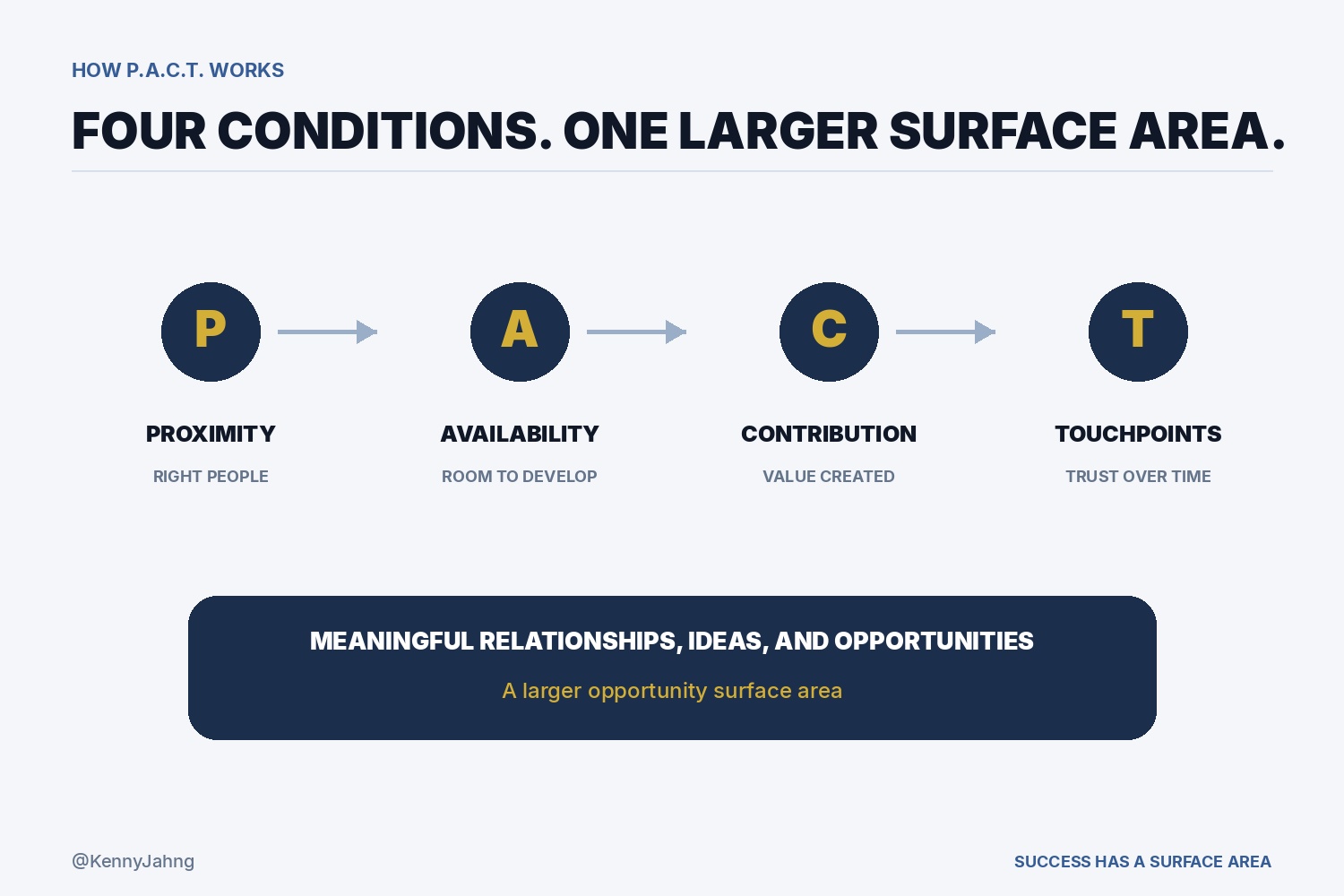
You create the conditions that make serendipity more likely. I use the P.A.C.T. Framework to describe those conditions: Proximity, Availability, Contribution, and Touchpoints.
P: Proximity
Proximity means consciously choosing the people and environments that surround you.
You have probably heard that you become the average of the five people closest to you. The exact number matters less than the principle. The people around you influence what you see, expect, attempt, and believe is possible.
Find people who are one, two, or three steps ahead of you. Spend time with people who are more experienced, more creative, more generous, or working on problems you have not encountered yet.
This requires leaving familiar circles. Attend the gathering where you know only one person. Join the class. Volunteer for the project. Participate in a community with people from different industries and walks of life.
Proximity is about choosing environments that expand your perspective and elevate the quality of your conversations.
The quality of a room matters more than its size.
A: Availability
Availability means creating enough margin for something unplanned to happen.
If every hour is spoken for and every answer is already settled, there is no room for a new possibility to take hold.
Availability may mean staying after the meeting. It may mean accepting an invitation that does not have an obvious business outcome. It may mean leaving your phone in your pocket during dinner. It may mean allowing a promising conversation to continue for another twenty minutes.
This applies to mental availability, too.
Curiosity keeps you receptive. Humility allows someone else to challenge your assumptions. Discernment helps you recognize when a passing comment deserves further attention.
You do not need to chase every idea or accept every invitation. You need enough margin to recognize and explore the right ones.
C: Contribution
Contribution means entering relationships with a posture of generosity.
Many people walk into a networking environment thinking about what they can get. A transactional posture places pressure on every conversation. It also makes the relationship easy to forget.
I try to be two clicks more generous than selfish.
That means proactively looking for excuses to help someone else move forward.
Send the thank-you note. Share the notes you took at the conference. Make the introduction. Follow up with an update. Forward an article that addresses the problem someone mentioned. Send the book instead of merely recommending it.
Contribution begins with paying close attention. You remember what someone is building, what challenge they described, and what resource might help them.
The practical question is:
How can I become an indispensable relationship in this person's journey?
Indispensable means becoming known as someone who listens, remembers, follows through, connects dots, and contributes without keeping score.
In my experience, good things multiply when you focus on helping other people make progress. Trust grows. Conversations deepen. People remember who paid attention and who helped.
T: Touchpoints
Touchpoints are repeated, meaningful interactions over time.
Adults often place too much pressure on a single meeting, meal, or event. We meet someone once, decide whether we clicked, and wait to see whether the other person initiates something.
Relationships usually develop through repetition.
Research estimates vary, and the exact number is less important than the pattern. Thirty, forty, or fifty interactions create familiarity and shared context that one impressive conversation cannot reproduce.
This is why people develop friendships through classes, volunteer teams, churches, small groups, clubs, and recurring events. They see one another regularly. Conversations continue. Shared experiences accumulate. Trust develops naturally.
I use a similar concept in marketing called the Law of 7 to 11. People often need seven to eleven meaningful interactions with a brand before they open their decision process and seriously consider it.
Relationships also have a familiarity threshold.
One conversation can begin a relationship. Repeated touchpoints allow it to deepen.
This means following up after the event. It means creating a reason to reconnect. It means joining environments where you will see the same people again. It means sharing an update so the other person knows what happened after your conversation.
Every touchpoint adds another layer of context, familiarity, and trust.
Make a P.A.C.T. Against Isolation
The P.A.C.T. Framework gives founders a practical way to increase their opportunity surface area:
- Proximity determines who and what surrounds you.
- Availability creates room for something unexpected.
- Contribution makes the relationship meaningful and useful.
- Touchpoints allow familiarity and trust to grow over time.
These four conditions reinforce one another.
Proximity introduces you to the right people. Availability gives the interaction room to develop. Contribution creates value for the other person. Touchpoints transform an encounter into a relationship.
Why We Are Creating Builder Conference
This is the type of environment we are building at Builder Conference in Jackson, Wyoming.
We are curating a room filled with founders, builders, leaders, dreamers, and world changers. We want people who are generous with their experience, honest about what they are learning, and interested in helping other people see possibilities more clearly.
The goal is to create the conditions for meaningful things to happen.
You may meet a future collaborator. You may hear the sentence that unlocks a decision. You may discover a better model for something you are building. You may begin a relationship that makes sense only when you look back several years from now.
A thoughtfully curated room increases the probability of those outcomes.
That is the opportunity surface area.
Expand Your Surface Area
Your next breakthrough may emerge during another week of focused work.
It may also begin with a conversation you cannot have from your current desk.
Choose your proximity. Protect your availability. Lead with contribution. Invest in repeated touchpoints.
Success has a surface area. Make a P.A.C.T. to resist isolation and create more opportunities for meaningful things to happen.
Learn more about Builder Conference at stackhouseventures.com/builder-conference.