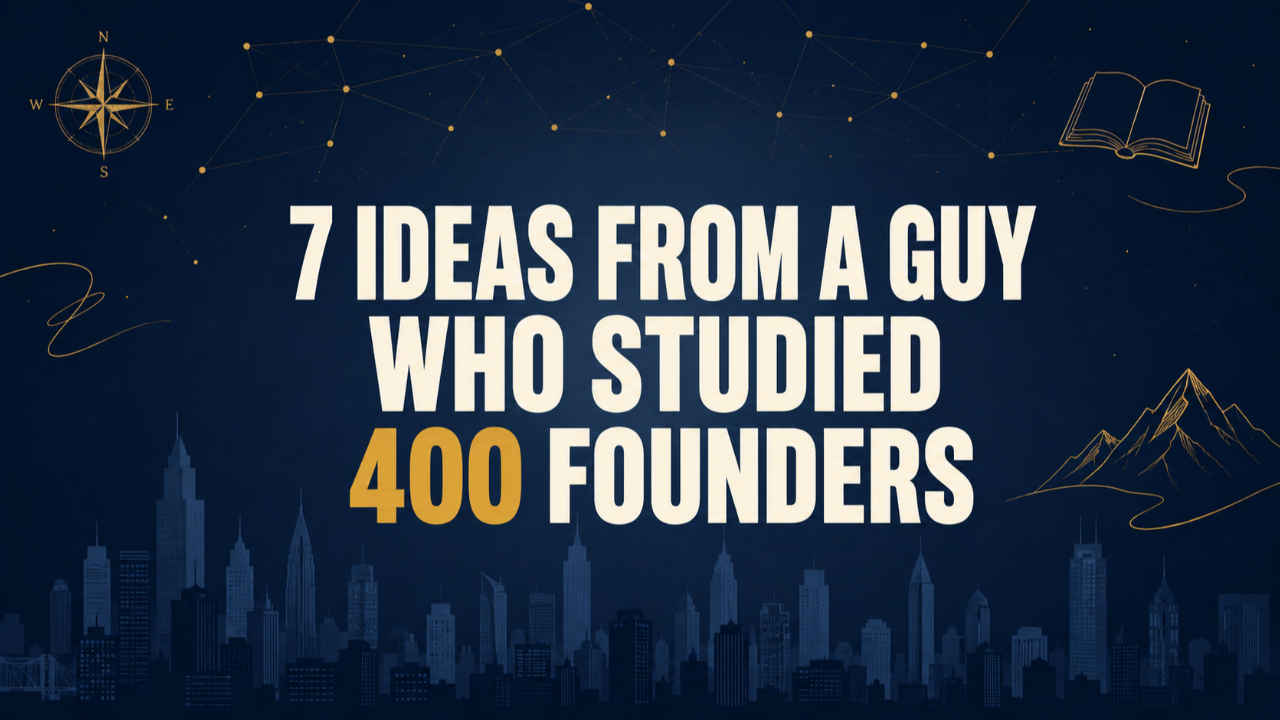
7 Ideas From a Guy Who Studied 400 Founders
Jul 07, 2026I just watched Brian Halligan interview David Senra on the Founders podcast, and I'm still thinking about it days later. Senra is the guy behind the Founders podcast, and he has gone deep on more than 400 founders across history. Rockefeller and Carnegie. Steve Jobs and Jeff Bezos. Jensen Huang, Elon Musk, and dozens more. The full conversation is embedded below and it's worth every minute of your time.
Here are the seven takeaways I pulled from the conversation that hit hardest for me as a ministry entrepreneur running Big Click Syndicate, AI For Church Leaders, and Stackhouse Ventures.
1. Mute the World and Build Your Own
Senra's phrase for this is "mute the world and build your own." The founders who go the distance stop scanning what everyone else is doing and just build what they want to see. They stay heads down on their own thing.
The pull to do the opposite is strong for anyone building in a crowded space. Scanning what other operators are shipping. Watching every new tool launch in your category. Every hour spent on that is an hour taken away from building your own work. Senra's point is that the great ones close those tabs early and keep them closed.
2. Focus Means Saying No to Good Ideas
Jony Ive told a story about Steve Jobs pushing him on how many things he'd said no to. Real focus shows up as a no to good ideas because a good idea will pull you off the great idea.
I've got three or four good projects sitting in my Notion right now. Every one of them would probably work. That's exactly why they're dangerous. They pull attention away from the thing I should be going deeper on. Saying no to something you actually want to do is the hard part of focus.
3. Founder-Problem Fit Beats Everything
Daniel Ek is funding a project to map founder archetypes because he wasted years imitating Steve Jobs before realizing he's a coach type. Senra's takeaway from that conversation is that the most important fit is founder-problem fit. It sits above product-market fit. It sits above founder-industry fit.
For me the question becomes simple. Am I working on the problem I was built for? Church leadership plus AI adoption plus ministry effectiveness sits at the intersection of everything I've been trained for: an MBA from Columbia, an M.Div from Princeton Seminary, and 20 years in ministry work. That's my problem to solve. Everything I build needs to serve that problem.
4. The Fuel Source Has to Change
Brad Jacobs told Senra his inner drive needed to shift at some point. The negative fuel that gets a founder started stops serving them later on. The move is toward generative drive. Building because you love the work and want to make something good for the world.
I see this pattern in a lot of the entrepreneurs I coach and consult with. Early on, the fuel is proving something. Earning a seat at a table. Answering somebody who counted them out. That gets them moving, and it works for a while. Then it runs out, or it starts eating them from the inside.
The founders Senra studied who lasted 30 or 40 years in one thing were operating from love. That's the fuel that carried them across decades. Worth paying attention to for anyone building something they want to still be building in year 20.
5. People Over Ideas
Ed Catmull, the founder of Pixar, told Senra that ideas come from people, so people are the whole game. A great team fixes a mediocre idea. A mediocre team wrecks a great one.
That reframes how I think about the year ahead. My real leverage is the team around me. If I invest in them and give them the resources and clarity they need, the ideas take care of themselves. Without that, the best strategy in the world falls apart in execution.
6. Control Is the Real Motivator
Senra made the point that small egos don't build big companies. The primary motivator for great founders is control over the work. Money follows as a side effect.
That's a useful lens for the kind of decisions every operator eventually faces. Does this move give you more control over what you're building, or does it hand a piece of it away? Is this a today problem being solved with a future cost? Those tradeoffs stack up fast, and once you lose control of your work, you rarely get it back.
7. Stay in the Game Long Enough to Get Lucky
Elon founded SpaceX at 30. That was 25 years ago and he's still building it. Bezos did the same with Amazon. Zuckerberg with Facebook. The pattern is clear across every founder Senra has studied. Longevity in one thing beats jumping between five things. Second-time founders are rare. Third-time founders are even rarer. Most of the generational outcomes come from the first thing, taken all the way through.
Senra's line for this is stay in the game long enough to get lucky. You handle each opportunity well and it opens up the next one. Nobody could have predicted the size of the outcome 20 years in, and that's the whole point. Show up on the same work long enough for luck to find you.
Closing Thoughts
At the end of the interview, Halligan asked Senra what advice he'd give founders. Senra said the best entrepreneurs do NOT need advice. WHAT???
They're irrepressible forces of nature.
They find the information themselves.
BUT, learning is still the point.
Permission is the part to STOP looking for.
Nobody outside your own head is going to tell you your work is important enough or your calling is real enough.
That's your job to know.
And then to wake up every day and get after it for a long time.
Do you agree with that last part?